It actually happened about a week after the one-month mark, but I went in this past Monday for my first check-in with my PCP since beginning PrEP. This visit was really just for two things: a kidney panel to make sure that my kidney function hasn't been impacted by the Truvada; and the next booster for the Hep A/B vaccine that I needed.
The kidney labs came back yesterday (according to my PCP, my kidney function "looks great"). Unfortunately, so did a swift kick from the vaccine. Normally vaccines don't cause me any side-effects, but I've been sleeping badly for the past week, so I'm sure I wasn't at 100% to begin with. Anyway, yesterday and today I've been feeling run down and just sort of overall crummy. A little better today but, well, it sucks.
Two more months til my next PrEP check-in with my doctor. That visit (which will take place three months into my PrEP prescription,) will cover a lot more: full-panel HIV/STI tests, liver and kidney labs, cholesterol check, and my yearly physical. Not all of that is required to stay on PrEP (just the HIV test and liver/kidney labs), but it's a handy opportunity to cover more ground anyway, so why not take advantage?
Still at 100% adherence.
Cheers, folks!

Truvotter PrEP School | TruvotterPrEP.org - Pushing back against stereotypes and stigma against PrEP and HIV.
Showing posts with label HIV Testing. Show all posts
Showing posts with label HIV Testing. Show all posts
Wednesday, February 17, 2016

Wednesday, February 10, 2016
One Month!
[T-Plus 30 Days. A Month!]
Yep, you read that right (and if you've been following the blog, you've maybe been waiting for it)... As of fifteen minutes ago, I took my 30th dose of Truvada, on the 30th day of my prescription. 100% adherence, folks!

Finished my first bottle tonight!
Looking back, it's been a hell of a month: the first few days with my prescription were completely smooth, followed by about a week or so there with some pretty constant, low-grade nausea (which, to be fair, I could have gotten a prescription for, but really it was never bad enough to ruin my days or interrupt my work, and I tend to be the type that avoids extra prescriptions when I can). That nausea went away pretty quickly after that though, and since then it's been wonderful.
I've had to use my travel meds bottle repeatedly, which makes me really glad I made the thing. I think I've refilled it a half dozen times so far.
My prescription refills automatically until my doctor or I cancel it, so there's never a lapse in doses, but I do still have to go in to see my PCP this coming Monday so that I can get labs drawn (an HIV test and a liver function test this time). Assuming that goes well, I won't have to go back again for another two months.
My prescription refills automatically until my doctor or I cancel it, so there's never a lapse in doses, but I do still have to go in to see my PCP this coming Monday so that I can get labs drawn (an HIV test and a liver function test this time). Assuming that goes well, I won't have to go back again for another two months.
People have asked me a lot of questions about PrEP (online and elsewhere). They've also asked me a lot of questions about me, which I definitely brought on myself to a degree by being so vocal about going on PrEP (I'm "out" to friends and family about being on it), but which I still find kinda uncomfortable sometimes (I told you I was on PrEP, not that I wanted to share my detailed sexual history with you...).
Oh, and I got my next bottle of Truvada last night (you can see it above), and with it, a big reminder about how important the copay card and insurance are. You can see it in the picture below (I made a meme out of a part of the pharmacy receipt):

Yep, that's a bit of my actual pharmacy receipt.
After insurance and the copay card, I paid nothing for my Truvada. Before? That one bottle of 30 pills would have cost nearly $1,800 retail, which works out to about $60 per pill. There might be some folks who can swing that totally out of pocket, but I am definitely not one of them (they don't pay Case Managers/Social Workers much here in the US). Cost is definitely a consideration when it comes to medications (though ideally it never should be); it's a big deal that there are options to make the safety PrEP affords accessible for many people. There need to be more options now, for everyone.
Now on to month two... Cheers, folks!
Sunday, February 7, 2016
February 7th is National Black HIV/AIDS Awareness Day

Communities of color are still disproportionately impacted by HIV the US, and until recently, very little has been done to change that. February 7th is National Black HIV/AIDS Awareness Day. The best way to celebrate is to make a plan: get tested, know your status, talk to your doctor about risk, and talk to partners and friends about prevention.
Learn more at: http://nationalblackaidsday.org/
Saturday, February 6, 2016
PEP, PrEP, and TasP
[T-Plus 26 Days... Almost a month!]
26 days and 26 pills into my first prescription for PrEP. I can't believe it's been nearly a month already! Sure, it was rough at first, but it's been great for the past couple weeks now. There have been some really interesting social side-effects to getting on it that I didn't expect, though.
The first of these is that many people seem to feel a lot more entitled to ask me questions about my sex life. That isn't a problem for me, since a lot of my work involves talking about different aspects of human sexuality, but it's still surprising. A lot of those sorts of questions ultimately come down to asking me why I'm getting on PrEP: do I have an HIV-positive partner? (I don't, but I could!) Do I want to have sex bareback? (Sure, sometimes, but that's not really why I'm on PrEP.) How risky am I, exactly? (Depends on a lot of things.)
The other thing that I've found is a lot of confusion about PrEP versus other medication-based prevention methods (when people have even heard of them). There are a lot of ways to prevent HIV transmission, but there are really only three major types that use medications at the moment: PEP, PrEP, and TasP. To make these a little easier to tell apart, I made a chart, which you can take a look at below (I'll describe the three prevention methods in more detail in a moment).

PEP, PrEP, and TasP - Three Medication-Based HIV Prevention Methods.
Alright, so the one thing that all three of these prevention methods have in common is that they all involve getting a prescription for one or more HIV medications (anti-retroviral therapies/medications, or ART's). The medications work exactly the same way inside the body no matter why a person is taking them, though different medications prevent the virus' activity in lots of different ways. Each method is intended for a different stage in HIV's "life-cycle".
Please forgive me in advance, but for the sake of making these prevention methods a little easier to understand, I'm going to use the analogy of hormonal birth control. I know it's drastically over-simplifying things, and I'm not trying to compare pregnancy to illness except very, very loosely. Okay...
PEP - Post-Exposure Prophylaxis - PEP is a method of HIV prevention for emergencies; a person who believes they're HIV-negative (a doctor will confirm this before prescribing PEP) and thinks or knows that they've just been exposed to HIV can get a prescription for one or two ART meds to stop the infection from taking hold before it can get started. PEP is a short-term prescription, normally lasting for about a month. PEP is usually prescribed by an emergency room doctor (because it has to be prescribed within 72 hours of the suspected exposure), but it can be prescribed by a Primary Care Provider as well.
You can think of PEP as being like the morning-after pill for HIV: you get it right after sex (or blood contact, in the case of PEP) to stop things right after the fact.
Strict adherence to a PEP regimen is necessary to ensure it is most effective.
PrEP - Pre-Exposure Prophylaxis - PrEP is a medium- to long-term prevention strategy that involves getting a prescription for a single, daily ART pill (presently Truvada, which contains two medications - tenofovir disoproxil fumarate and emtricitabine) in order to prevent HIV infection in people that are confirmed to be HIV negative. Going on PrEP is a commitment, because as with PEP, strict adherence ensures that PrEP is most effective, but taken regularly and on time, taking PrEP can prevent HIV infection even through repeated exposures over an extended time.
People get on PrEP for a lot of reasons: yes, some because they absolutely hate condoms; but also for some because they have an HIV-positive partner (or might not want HIV to stand in the way of possible future partners); because they use IV drugs or have a lot of anonymous sex; or because they simply want to reduce their risk for contracting HIV. Most people take PrEP for some months to years during periods of higher risk for HIV infection.
You might think of PrEP as being a bit like going on the pill - it's a daily dose of a medication that, if taken properly, stops things in advance.
TasP - Treatment as Prevention - TasP refers to people who are HIV-positive, who are adherent to their HAART regimen and virally suppressed (the amount of active virus in the person is "undetectable" - so little that it's virtually missing when a doctor looks at their blood). A person who's HIV is undetectable has a much, much lower chance of transmitting their virus to a partner regardless of any other prevention methods. Yes, you read that right - an HIV-positive person whose virus is well-managed can theoretically have unprotected sex, even repeatedly, and not pass on the virus to their partner. This doesn't mean a condoms shouldn't be part of the equation, too (that goes for PrEP as well), but it means that with good medical care, safe and active sex-lives are possible for and with poz folks.
The birth control metaphor kind of falls apart here. A better analogy for TasP might be taking medication to treat herpes - it's a lifelong regimen, but while on it, the risk of transmission is reduced.
As with PEP and PrEP, strict adherence to a HAART regimen is necessary to ensure the greatest risk reduction.
I hope this post has been helpful for some people. You're more than welcome to share the image above, as long as you don't crop or edit it in any way. You can find a shareable post - including the chart - on Truvotter PrEP's Facebook page.
Saturday, January 30, 2016
Busy Week, But Still On Track
[T-Plus 19 Days.]
I can't believe it's been nearly a week since I last posted! What a week it's been, too; between work, starting another semester of grad school, and adulting the crap out of my day to day chores and stuff, I haven't had a lot of time to post. I have been keeping up with my adherence thoough. Check it out:

Keepin' on track.
Bam! Okay, so the "monthly" adherence bit is a little misleading, since I started PrEP on January 12th, but still, even with a super busy week, I've managed to keep on track with my daily dose every single day so far. Being this busy has made me pretty thankful for that emergency pill bottle I put together, though! I refilled it twice this week; four out of the last five days I've taken my Truvada away away from home, whether at class, at work, or out with a friend. In class, I talked to my professor in advance, and just let her know that I had a medication I have to take at 7pm each day. She was totally fine with it, and I was able to take my pill in class on a break she offered right around dosing time (you can see it there on Thursday, in the picture above). So, pretty proud of myself for keeping on schedule.
The funny thing is, getting myself organized around taking my PrEP every day has helped my adherence to my Lisinopril (a blood pressure medication) tremendously. Maybe it's just that the app is making me more aware of my dosing times, but I think there's more to it than that; I think that the motivation I've had to get and stay on PrEP has encouraged me to be more engaged with my health overall. It's a good feeling. So is having a consistent, guaranteed appointment for HIV/STI testing and labs - I've always been a fan of knowing about my health... and TERRIBLE at scheduling... so having something mandatory and predictable is fantastic.
Hey, and my side effects are just about completely gone! I gotta say, it was kinda crummy those first couple weeks, building up protection but not feeling good enough to, um, use that protection. Look, I know what you're thinking, I can hear the "Truvada whore" comments starting to bubble up, but I'm being honest here; I want to get laid. Um, duh. Not crazy, run-to-the-bathhouse and f*ck ten guys kinda laid, but something. And it sucks not feeling like it. But two weeks worth of feeling a little off is nothing compared to the alternative. So, I'm not complaining.
Cheers, friends.
Wednesday, January 20, 2016
Day Eight - First Week of Protection
[T-Plus 8 Days.]
Eight days and eight pills in, and I think I'm starting to get myself on a routine - I've been using my app to track my adherence (it's actually kinda satisfying to be able to look back at see "100% Adherence" on my medication report), and so far I've managed to take my meds within about 30 minutes of the reminder I set (currently 7pm, or right around dinner time so that I have something in my stomach when I take my dose).
Truvada doesn't have to be taken with food - Gilead points out that "food does not affect how Truvada works" - but upset stomach is one of the most common side effects of the medication, and I have a sensitive stomach, so I'm all about taking precautions - remember, if you throw up a dose you just took, that dose is lost. If you caught some of my previous posts, I had a couple of rough mornings a couple of days in (this past Friday and Saturday) when the nausea was worst, but since then that's passed, and this morning I felt pretty normal (for whatever that's worth...).
So now the trick is gonna be keeping up this new routine; I'd like to be able to go into my first follow-up appointment having taken every one of my pills on time. This has a couple benefits for me: if nothing else, it means I've been as protected as I can be for the entire past month, but besides that it also tells me that my kidney function labs (which they'll draw at that first follow-up) will be as accurate as possible. It doesn't seem likely at this point that the Truvada has been hurting my kidney or liver function (I'm not experiencing jaundice, or any other sign of renal failure), but ya never know until you check.
Week one of meds went great - here's hoping the first week of protection goes at least as well.
Cheers, friends!
Tuesday, January 12, 2016
T-Minus NOTHING!
[T-Minus 0. ZERO!]
Cheers, friends!
Alright, so last week I snagged a Gilead copay assistance card (you have to get one and activate it beforehand, so that when you go to pick up your script, they can apply the additional assistance). Of course, I promptly forgot that I took one, and so it lived in my bag, totally inactivated, until yesterday. Yeah, I'm a horrible procrastinator.
SO, yesterday I pulled it out and finally called. The process was super easy - a series of automated menus, and a few prompts for my name and phone number, and then it was active. Easy! The whole process took me about 7 minutes. I'm so glad I did it, too - but I'll get to why in a second. There's one really important thing to know about the copay assistance program: it is not available for people on Medicaid/Medicare, or anyone receiving any sort of state or federal assistance (such as participating in a state-run Drug Assistance Program). Gilead's program is specifically designed to make their medications accessible for those who can't get other assistance - those without insurance, those whose insurance doesn't cover Truvada (or does, but at an extremely high copay, as mine does), and so on. Make sure that you know all of your options for assistance before you plan to start filling scripts - there is no reason that any person should not be able to get Truvada for PrEP (or for HIV treatment) because of cost. Period.
Okay, so copay assistance card, check. That done, I went to my follow-up appointment with my doctor yesterday afternoon. I'd already gotten the results of my initial labs (an HIV test and liver and kidney function panels), which all looked good (no HIV, liver and kidneys doin' their thing), but in order to get on PrEP, standard practice is to perform a follow-up (confirmatory) HIV test. They took some blood, and I headed home; my PCP had explained that he should have the results the next morning, and that if they were clear, then he'd call in the prescription.
This afternoon, I got a text from my pharmacy that I had a prescription waiting. When I got off of work, I ran over and picked up my prescription (copay card in hand). Remember I mentioned that I was really glad I'd activated that card? Well, the reason why: my prescription was free. Yep, totally free... after insurance and the copay assistance, I walked out the door with a month's supply of HIV prevention with as much little money as I had when I walked in.
Not everyone is going to get their meds for free - even the best insurance and discount programs have some limits. I have decent insurance, so my copay was high, but still low enough to be completely covered by the copay card. Still, given the variety of programs available, there are options to make Truvada affordable for virtually anyone.
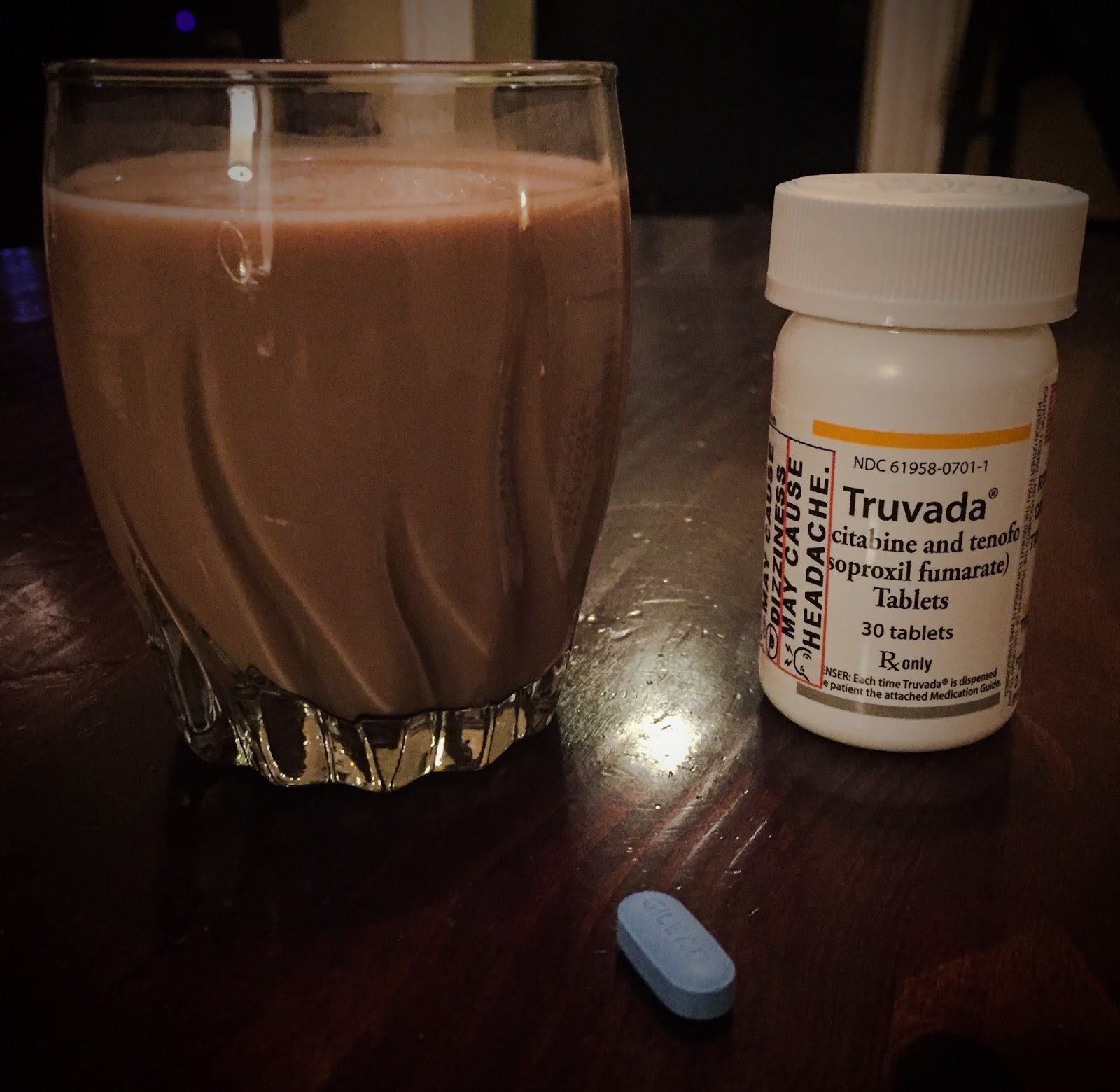
Well, so there it is! I took my first dose tonight with a glass of chocolate milk (Truvada can cause nausea for some, so many people recommend taking it with food). Over the next several days, I'll update y'all about my experience beginning to take PrEP, especially any side-effects.
Cheers, folks!
Wednesday, December 16, 2015
Weighing the Risks - Side Effects and Such
[T-Minus 26 Days.]
There are risks to starting any medication. Of course there are. Starting any new medication means facing down potential side effects, not to mention adding a new routine to one's day or week or month. It means adding another visit to the pharmacist, and everything that entails (including potentially awkward conversations with the pharmacist about this medication or that). It means more frequent visits to the doctor.
I want to say that I spent a lot of time considering the side effects of PrEP, and other issues mentioned above, but I didn't. From the outset, Truvada (PrEP) was described to me as incredibly safe and reliable - even a couple of years ago, there was substantial evidence that PrEP was extremely effective. Besides, I already take a couple medications regularly, so adding another to the mix really isn't going to change my routine that much. The pharmacist still makes me a little uncomfortable, but not because of PrEP - it's just always felt like picking up or discussing medications should be a more private thing (but I deal with it). And I like my doctor, not to mention I enjoy being healthy in a general sense, so having a good reminder to check in more often isn't exactly a bad thing. And I'm fortunate to have good insurance and a good job, so the cost of the extra appointments and things isn't as big a deal for me as it might be for some.
As I've gotten a bit closer to starting PrEP, I have gotten a little more anxious about side effects though, so I did a little research into the specifics. Check out a section from Gilead's prescriber's guide for Truvada for PrEP below, as well as the company's website for individuals interested in PrEP.

For those taking Truvada for PrEP, the most common side effects were "headache, abdominal pain and decreased weight," and the incidence was incredibly low. It really seems pretty damn safe. I can deal with a headache or an upset stomach for a bit (in my experience, side effects from meds don't tend to stick with me for very long). Decreased weight is maybe something to consider, but of course I'll be going to the doctor every few months while I'm on PrEP anyway, so I can always talk about diet if my doctor or I ever feel like I'm losing too much weight - not likely!
Of course, there's a cost aspect to taking PrEP, too. I'm choosing to voluntarily take a daily medication that even on my decent insurance is a bit pricey. Still, relative to a lifetime of medical care for HIV, I think PrEP wins financially, too. Besides, there are programs all over that can potentially help subsidize the cost of Truvada for PrEP. I'll talk more about this in an upcoming post, but if you need cost assistance now, Gilead has a fantastic copay and prescription assistance program.
Ultimately, my decision to take PrEP has been about deciding how much risk (physical, social, financial, etc.,) I'm willing to accept in taking it, versus my risk for HIV infection. It's no small thing - taking it or not, either could have a major impact on my life.
For me, the choice feels easy (I feel that in my case, it's a fairly cheap and very effective way to enhance my protection against HIV,) but for you reading this, maybe that's not the case. That's okay, too! There are loads of other prevention options, if PrEP isn't right for you. If it is, and you're just not sure how to talk about it (or a bit scared to,) there are lots of fantastic resources to help start that conversation - and lots of great doctors that are willing to have it, too!
For resources about PrEP, HIV/Testing, and HIV/AIDS in general, click on the Resources tab near the top of the page.
More soon. Happy Winter Holidays, folks!
Monday, December 14, 2015
Layers of Protection - Condoms (and PrEP)
Condoms are a really big issue, no matter one's sexuality. They certainly have been for me, though not always in the best ways.
I think the first time I really thought about condoms was early in high school, during one of those really awkward, way-too-late "birds and the bees" conversations that we're stereotypically expected to have as kids. One frigid morning in the middle of winter (probably late January), my dad got me up reeeeeally early in the morning. He told me we should go for a drive (cue teenage apprehension). We got on the road, and got going a ways, before my dad tossed out the (basically expected) reason we were going for a drive. He asked me if I had any questions about sex (I didn't), and then told me if I ever needed condoms and was too embarrassed to buy them, to let him know. I got really nervous and mumbled some sort of thank you. To that point, I had never really thought about condoms at all - I was a nerdy kid who wasn't dating, and besides, was struggling to accept his sexuality.
Many of us don't think about condoms much, for a long time. Sure, we might hear about them awkwardly form our parents, or perhaps in Sex-Ed in school if we're lucky (I didn't, much), but in general discussing condoms is something we're really bad at in the United States. Worse, frequently when we do talk about them (at least among men), it's to rationalize why we should't/can't/won't wear them. I've had dozens of male friends who refuse to wear condoms for one reason or another. I'll admit (a little ashamedly) that all through my twenties I did that, too. I had a hard time finding ones that fit me, from the little bit I tried, and so pretty quickly I stopped bothering to even look. I just came up with excuses.
So yeah, for a long time, I didn't use condoms. Maybe the act "felt better", a little, but I didn't. Every time I had sex without a condom, I ended up going through a good week or two guilt period afterward. Sometimes that guilt would last even longer - until my next HIV/STI panel. Not knowing if you just got syphilis is not a happy place to be!
Working on stepping up my condom usage is something I've spent a lot of time on over the past few years or so. I started doing my research. I read articles, perused websites, but most importantly, I got small packs and samples of a bunch of different condoms and then tried I them on. Yep, I probably tried a dozen over the course of a few months, until I found a few brands and types that work really well for me.
I thought about a few big things - pros and cons, desired attributes, etc., - to condoms when I was making my decisions:
Condoms aren't 100% fool-proof when used alone. They can break. They can come off. Other things can happen to them to make them unreliable (this is NO EXCUSE not to use them!)
Some people have latex allergies that make it difficult to wear typical condoms. Condoms made of natural materials can be more porous, and frequently only protect against pregnancy, but not HIV or other STI's.
Condoms need to be put on the moment you plan to start any sort of penetration. This is easily forgotten. And yeah, I get it, it's pretty gross to give a blow job on rubber (and sure, oral sex is less likely to transmit some Sexually Transmitted Infections,) but honestly, if you don't know your partner well, it's best to use a condom then, too.
Condoms can be really freaking hard to put on when drunk!
But on the flip side...
Condoms are pretty damn effective - they are among the cheapest and most effective forms of prevention against unwanted pregnancy and STI's around.
There are numerous alternative synthetic materials that condoms can be made of, ensuring that there is a safe, comfortable condom for nearly everyone.
Keeping a reasonable supply of non-expired condoms in different places (that aren't too hot or cold), such as by your bed, makes grabbing a condom easy.
For me, this one has become easy, since I've resolved to give up drinking for a while, but more importantly, if you're drunk (and particularly if your prospective partner is), you should probably reconsider having sex anyway, as consent can't be given by a drunk person.
Condoms come in a variety of shapes and sizes. I personally tend to need slightly smaller condoms for comfort and to make sure they fit snugly, but of course people are a variety of sizes, and ultimately the goal is to find a condom that fits properly and feels comfortable. According to some research, much of men's discomfort and trouble around wearing condoms may stem from using the wrong size on our... stems. For guys who are a bit larger, there are of course XL varieties of condom.
I think the first time I really thought about condoms was early in high school, during one of those really awkward, way-too-late "birds and the bees" conversations that we're stereotypically expected to have as kids. One frigid morning in the middle of winter (probably late January), my dad got me up reeeeeally early in the morning. He told me we should go for a drive (cue teenage apprehension). We got on the road, and got going a ways, before my dad tossed out the (basically expected) reason we were going for a drive. He asked me if I had any questions about sex (I didn't), and then told me if I ever needed condoms and was too embarrassed to buy them, to let him know. I got really nervous and mumbled some sort of thank you. To that point, I had never really thought about condoms at all - I was a nerdy kid who wasn't dating, and besides, was struggling to accept his sexuality.
Many of us don't think about condoms much, for a long time. Sure, we might hear about them awkwardly form our parents, or perhaps in Sex-Ed in school if we're lucky (I didn't, much), but in general discussing condoms is something we're really bad at in the United States. Worse, frequently when we do talk about them (at least among men), it's to rationalize why we should't/can't/won't wear them. I've had dozens of male friends who refuse to wear condoms for one reason or another. I'll admit (a little ashamedly) that all through my twenties I did that, too. I had a hard time finding ones that fit me, from the little bit I tried, and so pretty quickly I stopped bothering to even look. I just came up with excuses.
So yeah, for a long time, I didn't use condoms. Maybe the act "felt better", a little, but I didn't. Every time I had sex without a condom, I ended up going through a good week or two guilt period afterward. Sometimes that guilt would last even longer - until my next HIV/STI panel. Not knowing if you just got syphilis is not a happy place to be!
Working on stepping up my condom usage is something I've spent a lot of time on over the past few years or so. I started doing my research. I read articles, perused websites, but most importantly, I got small packs and samples of a bunch of different condoms and then tried I them on. Yep, I probably tried a dozen over the course of a few months, until I found a few brands and types that work really well for me.
Watch a really cute guy prove that you absolutely can't be too big for a condom.
I thought about a few big things - pros and cons, desired attributes, etc., - to condoms when I was making my decisions:
Risks and Rewards
Condoms aren't 100% fool-proof when used alone. They can break. They can come off. Other things can happen to them to make them unreliable (this is NO EXCUSE not to use them!)
Some people have latex allergies that make it difficult to wear typical condoms. Condoms made of natural materials can be more porous, and frequently only protect against pregnancy, but not HIV or other STI's.
Condoms need to be put on the moment you plan to start any sort of penetration. This is easily forgotten. And yeah, I get it, it's pretty gross to give a blow job on rubber (and sure, oral sex is less likely to transmit some Sexually Transmitted Infections,) but honestly, if you don't know your partner well, it's best to use a condom then, too.
Condoms can be really freaking hard to put on when drunk!
But on the flip side...
Condoms are pretty damn effective - they are among the cheapest and most effective forms of prevention against unwanted pregnancy and STI's around.
There are numerous alternative synthetic materials that condoms can be made of, ensuring that there is a safe, comfortable condom for nearly everyone.
Keeping a reasonable supply of non-expired condoms in different places (that aren't too hot or cold), such as by your bed, makes grabbing a condom easy.
For me, this one has become easy, since I've resolved to give up drinking for a while, but more importantly, if you're drunk (and particularly if your prospective partner is), you should probably reconsider having sex anyway, as consent can't be given by a drunk person.
Sizes and Shapes
Condoms come in a variety of shapes and sizes. I personally tend to need slightly smaller condoms for comfort and to make sure they fit snugly, but of course people are a variety of sizes, and ultimately the goal is to find a condom that fits properly and feels comfortable. According to some research, much of men's discomfort and trouble around wearing condoms may stem from using the wrong size on our... stems. For guys who are a bit larger, there are of course XL varieties of condom.
Where to Buy
I prefer to buy my condoms from Amazon (yes, Amazon sells condoms!) The advantage of Amazon is that you can buy from a variety of sellers, frequently in varying levels of bulk (and typically for very cheap), and if you're concerned about privacy, remember that your condoms will come in a smiling Amazon.com box. People are as likely to think you bought a new Blu Ray. I have Amazon Prime, so my condoms ship with free Two-Day Shipping, meaning if I get low, I can restock quickly and easily. It's super efficient!
Condoms and PrEP
As I move forward with starting a PrEP Truvada regimen, I absolutely have to continue my condom use. Just as condoms aren't 100% effective, nor is PrEP! Not to mention, PrEP only prevents HIV transmission, but not any of the other STI's out there.
Just taking PrEP is NOT going to keep me from getting a nasty case of gonorrhea, or chlamydia, or syphilis. One major fear that many doctors still have in prescribing PrEP is that condom use will decline once patients are on it. Research is mixed (see here and here,) but in general, men seem to still continue to use condoms after beginning PrEP. There may be some decline, but condom use among men in the United States is drastically low to begin with - a much larger issue that needs to also be tackled.
Sunday, December 13, 2015
PrEP, It's Not Just For Gay Guys!
[I'm taking a really brief break from my personal reflections here, to put out sort of a PSA about PrEP for anyone reading this who doesn't identify as strictly gay or male. I myself identify as a queer man, and though I'm generally looking for other men, I have been with women as well, and it may happen again (sorry boys, no gold star here). Anyway, straight or gay, I think this information is important. Thanks, folks!]
That's right! PrEP isn't just for gay men... it's for bi and straight guys and women. Take a look at this slide from a Truvada for Prep training quiz (assembled by Gilead, the makers of Truvada):

Truvada (for PrEP) is indicated for any adult who is "at high risk for sexually transmitted HIV-1 infection".
This absolutely doesn't mean that every single person should be on PrEP. Not even every person at high risk should be. Every medical decision you make should be made in collaboration with your doctor and other relevant care providers; there are lots of great reasons not to take PrEP that your doctor can explain to you. The most important thing to do is to have an honest conversation with medical professionals that you know and trust. The process of beginning any medication or treatment should always be taken seriously, and only with proper information.
Part of busting down the stigma against HIV and PrEP is being informed: we know that HIV is not restricted to the LGBTQ community; though marginalized communities are certainly disproportionately affected by HIV, as the linked article points out, "(t)he majority of people living with HIV worldwide are straight (heterosexual)."
Regardless of your sexuality, and whether or not PrEP is right for you, it's always important to #knowyourstatus, and to look out for your sexual health.
If you're interested in learning more, Gilead has a fantastic website detailing PrEP for HIV- (negative) individuals. It's a bit text-heavy, but it's packed with a lot of useful information. Another resource to help start the conversation about PrEP.
If you'd like to get tested, virtually any Planned Parenthood can conduct tests for HIV and other STI's, not to mention most family doctors. For more resources, the CDC has a fabulous site dedicated to HIV testing, as well as a testing site locator.
Myths About HIV. (2015, April 7). Retrieved December 12, 2015, from http://www.thebody.com/content/art58887.html
That's right! PrEP isn't just for gay men... it's for bi and straight guys and women. Take a look at this slide from a Truvada for Prep training quiz (assembled by Gilead, the makers of Truvada):

Truvada (for PrEP) is indicated for any adult who is "at high risk for sexually transmitted HIV-1 infection".
This absolutely doesn't mean that every single person should be on PrEP. Not even every person at high risk should be. Every medical decision you make should be made in collaboration with your doctor and other relevant care providers; there are lots of great reasons not to take PrEP that your doctor can explain to you. The most important thing to do is to have an honest conversation with medical professionals that you know and trust. The process of beginning any medication or treatment should always be taken seriously, and only with proper information.
Part of busting down the stigma against HIV and PrEP is being informed: we know that HIV is not restricted to the LGBTQ community; though marginalized communities are certainly disproportionately affected by HIV, as the linked article points out, "(t)he majority of people living with HIV worldwide are straight (heterosexual)."
Regardless of your sexuality, and whether or not PrEP is right for you, it's always important to #knowyourstatus, and to look out for your sexual health.
If you're interested in learning more, Gilead has a fantastic website detailing PrEP for HIV- (negative) individuals. It's a bit text-heavy, but it's packed with a lot of useful information. Another resource to help start the conversation about PrEP.
If you'd like to get tested, virtually any Planned Parenthood can conduct tests for HIV and other STI's, not to mention most family doctors. For more resources, the CDC has a fabulous site dedicated to HIV testing, as well as a testing site locator.
Myths About HIV. (2015, April 7). Retrieved December 12, 2015, from http://www.thebody.com/content/art58887.html
Saturday, December 12, 2015
Test Anxiety
It's been a few days since I started the process to get on PrEP (T-30 days, hopefully!) If you're familiar with PrEP or read yesterday's post, you know that part of the process is getting tested for HIV. I'm a Case Manager at an AIDS Service Organization and I'm mostly good about my HIV/STI risk reduction (I use condoms most of the time, try to talk to every partner about safety, and know what I can do in bed that's more safe or less). Still, there's always risk, and so every time that I get tested I get a little nervous.
It's not nearly as bad as the very first time I got tested. Then, I was in my early twenties, and at the time living in a tiny little town in a tiny little rural part of New Hampshire (having dropped out of college for a bit). Everybody knew just about everybody back home, and I was absolutely terrified. Worse, there were no rapid tests then, and results had to be given in person, so I knew I was going to have to wait a while to get my results. In fact, it took a lot longer to get them than I expected - because of some sort of processing error, my result came in but I wasn't called until about a month later (when I called in myself, at that point basically frantic).
Getting tested since then has been a lot easier (not much can beat how rough that was); this is good, because really any sexually active person should be getting tested at least every six months. On PrEP, I'll be expected to be tested every three months, which seems very frequent, but has the benefit of forcing me to be especially aware of my status (and not just HIV status, either!)
I feel pretty good about what my results will be, but an important part of my own sexual health is to recognize when I am engaging in risky behaviors (though I haven't always been good about this by any stretch of the imagination), and to know the risk. For me that also means accepting that I may someday get a positive result (although of course, I'm going on this journey to PrEP to make that less likely). Of course I don't want a positive result, but I would much rather know than not, and frankly I owe it to my prospective partners to be as informed as possible.
So I'm a little nervous, but I'll deal with it. It's an important part of the process - not to mention being a sexually active adult!
Check out the video and website below for a quick discussion about HIV testing anxiety. It really is better to #knowyourstatus.
It's not nearly as bad as the very first time I got tested. Then, I was in my early twenties, and at the time living in a tiny little town in a tiny little rural part of New Hampshire (having dropped out of college for a bit). Everybody knew just about everybody back home, and I was absolutely terrified. Worse, there were no rapid tests then, and results had to be given in person, so I knew I was going to have to wait a while to get my results. In fact, it took a lot longer to get them than I expected - because of some sort of processing error, my result came in but I wasn't called until about a month later (when I called in myself, at that point basically frantic).
Getting tested since then has been a lot easier (not much can beat how rough that was); this is good, because really any sexually active person should be getting tested at least every six months. On PrEP, I'll be expected to be tested every three months, which seems very frequent, but has the benefit of forcing me to be especially aware of my status (and not just HIV status, either!)
I feel pretty good about what my results will be, but an important part of my own sexual health is to recognize when I am engaging in risky behaviors (though I haven't always been good about this by any stretch of the imagination), and to know the risk. For me that also means accepting that I may someday get a positive result (although of course, I'm going on this journey to PrEP to make that less likely). Of course I don't want a positive result, but I would much rather know than not, and frankly I owe it to my prospective partners to be as informed as possible.
So I'm a little nervous, but I'll deal with it. It's an important part of the process - not to mention being a sexually active adult!
Check out the video and website below for a quick discussion about HIV testing anxiety. It really is better to #knowyourstatus.
Subscribe to:
Posts (Atom)